Afro-Caribbean Culture, Garvey’s Vision and the fight for self-determination

Why Garvey's Vision Still Matters Today


By Norris R. McDonald

Afro Carib World, Updated, June 16, 2026

Afro-Caribbean culture emerged from centuries of resistance, resilience, and the preservation of African heritage throughout the Caribbean. Few figures have influenced this journey more profoundly than Marcus Garvey, whose philosophy of self-reliance, cultural pride, and self-determination inspired generations across the African diaspora. Today, Garvey's vision remains relevant as Caribbean societies continue to navigate questions of identity, sovereignty, economic independence, and cultural preservation in an increasingly globalized world.

Quite recently, the Government of Jamaica’s inroduced a Green Paper on Culture, Entertainment and the Creative Economy which was a positive, welcome, and necessary contribution to the national conversation about identity, heritage, and development. 

Norris R. McDonald, Author.

It rightly recognises culture as a source of social cohesion, national pride, and economic opportunity. It also seeks to strengthen the creative industries, preserve cultural assets, and leverage Jamaica’s extraordinary global cultural influence to generate employment and growth.

But is anything missing?

CULTURE AND THE LEGACY OF RESISTANCE

This is where the importance of national political assertiveness comes in. Afro-Caribbean culture was born in resistance to Babylonian “downpression”.

Its history is fundamentally one of resistance and must remain so. Any attempt to “whitewash” it or make it more palatable to imperialism is doomed to fail.

African and Caribbean History must be a weapon of truth to inspire a new generation of change agents

The language, spirituality, music, cuisine, and traditions that define Jamaica emerged from centuries of struggle against slavery, colonialism, racial hierarchy, and economic exploitation.

Culture became a weapon of survival. It preserved memory when official history sought to erase it. It nurtured dignity when social institutions denied it. It affirmed humanity in a world designed to suppress it.

Any meaningful cultural policy must begin with this historical reality. The plantation system sought not only to exploit African labour but also to extinguish African identity.

THE NEW FACE OF BABYLON

In today’s technological age, we must be aware of new forms of cultural conditioning that can undermine resistance and create new forms of mental dependency.

Young people, and society in general, are exposed to an endless stream of foreign content on social media, often knowing little about the Maroons, Sam Sharpe, Paul Bogle, Nanny, Tacky, or the deeper African foundations of Jamaican society.

That said, it is encouraging to see Caribbean and African content creators producing material—whether cartoons or political messaging—that advances our culture, politics, and way of life.

A nation that loses faith in its history eventually loses faith in its future.

The struggle for cultural survival did not end with Emancipation or Independence; it simply changed form.

For Rastafari, Babylon represents more than colonial government or foreign rule. It symbolises systems of domination that diminish human dignity, promote dependency, and encourage people to reject their history and identity.

GARVEY’S PHILOSOPHY OF SELF-EMANCIPATION

Marcus Garvey understood this challenge and became a national and global icon of cultural and political resistance.

Garvey's work through the Universal Negro Improvement Association stressed black politocal, cultural and economic empowerment. He  recognised that political freedom without economic empowerment is incomplete. A people who depend entirely on others for employment, investment, production, and development remain vulnerable, regardless of constitutional arrangements.

The Philosophy and teachings of the Right Hon. Marcus Mosiah Garvey strongly focused on self-emancipation. 

Self-emancipation, therefore, became central to his philosophy.

It is little known that Marcus Garvey was of Coromantee Maroon descent. His political vision reflected a tradition deeply embedded in Jamaica’s emancipatory experience.

The Maroons fought not merely for physical survival but for the right to govern themselves.

Garvey expanded that struggle onto a global stage, arguing that true freedom requires political independence, cultural confidence, economic self-reliance, and the right of people to determine their own future.

Regarding Africa, Garvey was unequivocal: “Africa for the Africans.”

CUBA, VENEZUELA AND THE QUESTION OF SOVEREIGNTY

Regardless of one’s political views, Caribbean people should be concerned whenever external pressures threaten the ability of sovereign nations to pursue independent paths of development.

The principle at stake is larger than any single government—it is the right of people to determine their destiny without coercion.

This principle must apply to Jamaica, just as it applies to Cuba, Venezuela, and other nations facing external pressure.

A Jamaican cultural policy worthy of the nation’s history must affirm racial dignity, self-determination, and respect for national independence throughout the Caribbean.

CULTURE AS A WEAPON OF CHANGE

The Green Paper correctly identifies the economic value of Jamaican culture. Reggae, dancehall, athletics, cuisine, language, and fashion have made Jamaica one of the world’s most recognizable cultural brands.

Yet culture should never be reduced to branding alone.

Reggae did not emerge as a commercial product. It grew out of communities confronting poverty, inequality, and injustice. Rastafari was not born as a marketing strategy but as a movement dedicated to spiritual liberation and cultural affirmation. The Maroons did not fight for freedom so their history could become merely a tourism attraction.

The true value of culture lies not only in the revenue it generates but also in the consciousness it cultivates.

This is where the Green Paper can be strengthened. Greater emphasis should be placed on African heritage, historical literacy, oral traditions, community cultural institutions, and the preservation of indigenous knowledge systems.

Young Jamaicans should understand not only the economic value of their culture, but also its historical, political, and spiritual significance.

PROTECTING THE FUTURE

The future of Afro-Caribbean culture depends on more than government policy. It depends on whether Caribbean people continue to value their heritage, defend their identity, and preserve their capacity for independent thought and action.

Globalization offers opportunities, but it also creates pressure toward cultural uniformity. Digital technologies connect the world, but they can weaken local identities if communities fail to preserve their stories and traditions.

Black culture in the new technological age must be a powerful weapon of cultural resistance to resist the manipulation of our people's minds and, must be a mighty weapon of change.

The Green Paper represents an important beginning. However, Jamaica’s national vision should go further. It should embrace cultural sovereignty, racial dignity, economic self-reliance, and the right of Caribbean people to determine their own destiny.

That was the spirit of the Maroons. It was the message of Marcus Garvey. It also animates Rastafari’s critique of Babylon and its call for self-emancipation.

In the final analysis, culture is not simply what a people create; it is what enables them to remain themselves in a world constantly trying to remake them.

That is the bitta truth.

AUTHOR

Norris R. McDonald
Author, writer and cultural commentator exploring Afro-Caribbean heritage, identity, and global influence.

👉 Want more stories on Afro-Caribbean culture, history, and global influence? Follow Afro Carib World for deeper insights.


BREAKING NEWS

Afro-Caribbean Culture: Origins, Traditions, Black Identity, and Global Influence in 2026

Roots, Resilience, and Heritage in a Rapidly Changing World By Norris R. McDonald,  Afro Carib World Norris R. McDonald, DIJ Afro-Caribbean ...

BOOK


By Norris R. McDonald, DIJ

For centuries, Black people have been told that their suffering is divine punishment—ordained by God and passed down through a mythical “ancestral curse.”


In this powerful, eye-opening work, Norris R. McDonald, DIJ, dismantles one of the most enduring and damaging lies in Christian history: the so-called Curse of Ham. From the hymnals of colonial churches to the halls of modern academia, this myth has been used to justify slavery, colonization, and systemic racism.

With clarity, historical depth, and spiritual conviction, McDonald traces how scripture was distorted, how Black history was erased, and how liberation must begin with truth.

Drawing from the Bible, classical history, and Black theological thought, this short but impactful book challenges readers to confront religious indoctrination, reclaim their dignity, and break spiritual chains that have lasted for generations.
Whether you're a student of theology, an activist for racial justice, or a seeker of historical truth—
The Myth of the Ancestral Curse will inspire, inform, and empower you.

The Myth of the Black Ancestral Curse is a bold and revelatory work that exposes how colonial powers distorted Christian doctrine to justify the enslavement of Black people. From the Curse of Ham to papal decrees that sanctioned genocide, Norris R. McDonald, DIJ dismantles centuries of theological manipulation and calls for spiritual truth, historical clarity, and psychological healing.

This book is a journey—from ancient African greatness to colonial oppression, from religious lies to liberation theology. A must-read for seekers of justice, students of history, and defenders of faith rooted in freedom.

Afro-Caribbean Culture: Origins, Traditions, Black Identity, and Global Influence in 2026


Roots, Resilience, and Heritage in a Rapidly Changing World

By Norris R. McDonald, 

Afro Carib World


Norris R. McDonald, DIJ
Afro-Caribbean culture is one of humanity's most extraordinary stories of survival, resilience, and creativity. Forged in the crucible of slavery, colonialism, and displacement, it transformed suffering into strength and oppression into cultural innovation. Today, Afro-Caribbean traditions continue to shape global music, language, religion, politics, literature, fashion, cuisine, and social movements.

Yet the significance of Afro-Caribbean culture extends far beyond artistic achievement. In 2026, it remains a vital source of identity, belonging, and historical consciousness for millions of people throughout the Caribbean and the wider African diaspora. As societies grapple with economic uncertainty, political polarization, climate change, migration pressures, and renewed debates over race and historical memory, Afro-Caribbean culture provides a powerful reminder of the enduring strength of communities that refused to disappear.

The story of Afro-Caribbean culture is therefore not merely a story of the past. It is also a story about the present struggle for dignity, recognition, cultural preservation, and self-determination.

The African Roots of Afro-Caribbean Culture

The foundations of Afro-Caribbean culture were established during one of the darkest chapters in human history: the transatlantic slave trade.

Between the sixteenth and nineteenth centuries, millions of Africans were forcibly transported across the Atlantic Ocean to work on plantations throughout the Caribbean and the Americas. Families were separated, languages suppressed, and traditional social structures disrupted. Colonial authorities often attempted to erase African identities and impose European cultural norms.

Political, cultural resistance starts with knowing who we are as a people who come from great civilizations and, empowering ourselves to take control our life, community, society and countries.

Despite these brutal conditions, enslaved Africans resisted cultural annihilation. They preserved religious beliefs, storytelling traditions, music, agricultural knowledge, medicinal practices, artistic expressions, and social values that would become the foundation of modern Afro-Caribbean societies.

African traditions blended with Indigenous Caribbean influences and European cultural elements to create entirely new identities. The result was not cultural extinction but cultural transformation. Out of unimaginable hardship emerged some of the world's most vibrant and influential cultures.

The legacy of that transformation remains visible today in Caribbean languages, cuisine, spirituality, folklore, family structures, artistic traditions, and political consciousness.

Resistance and the Birth of Caribbean Identity

Afro-Caribbean culture was never passive. It was shaped through resistance.

Throughout the Caribbean, enslaved Africans fought against slavery through revolts, sabotage, cultural preservation, and the establishment of Maroon communities. These acts of resistance challenged colonial power and demonstrated an unwavering commitment to freedom and human dignity.

The Haitian Revolution remains one of the most significant examples of this struggle. It proved that enslaved Africans could overthrow a colonial regime and establish an independent nation. Across Jamaica, Suriname, Cuba, Barbados, Trinidad, and other territories, resistance movements left lasting marks on national identities.

The spirit of resistance became embedded within Afro-Caribbean culture itself. Music, religion, storytelling, and community institutions evolved as vehicles for preserving memory and affirming humanity in the face of oppression.

Today, that legacy continues to inspire movements for social justice, economic equality, and cultural recognition around the world.

Black Identity in an Era of Global Uncertainty

In 2026, questions of identity and belonging have become increasingly complex.

Across many countries, debates over immigration, race relations, citizenship, historical memory, and cultural representation have intensified. Social media has amplified both cultural pride and racial misinformation, creating new arenas for ideological conflict.

Black Culture in the technological age is a powerful instrument of change.

For Afro-Caribbean communities living throughout the diaspora—from Miami and New York to Toronto, London, Paris, Amsterdam, and beyond—the challenge often involves balancing multiple identities simultaneously.

Many young people navigate identities that are Caribbean, African, Black, national, and global all at once. While this diversity can be empowering, it can also create uncertainty about cultural roots and historical understanding.

In such circumstances, Afro-Caribbean culture serves as an anchor. It offers continuity in a rapidly changing world and provides a framework through which people can better understand their place within broader historical and cultural narratives.

Identity is not simply inherited. It must be cultivated, protected, and passed from one generation to the next.

Why Cultural Affirmation Matters

The affirmation of Black identity is not about exclusion or superiority. Rather, it is about recognizing the humanity, achievements, and contributions of people whose histories have frequently been marginalized or distorted.

For Afro-Caribbean communities, cultural affirmation involves preserving historical memory, celebrating African ancestry, supporting Black-owned institutions, teaching younger generations about their heritage, promoting accurate representations of Black life, and challenging stereotypes wherever they appear.

The need for cultural affirmation has become increasingly important as educational systems, media institutions, and political actors engage in ongoing debates about how history should be taught and remembered.

Communities that lose connection to their history often lose connection to themselves. Historical literacy strengthens cultural confidence and helps younger generations understand the sacrifices and achievements that shaped their present reality.

Preserving Afro-Caribbean culture therefore represents an investment in both memory and future possibility.

Music, Art, and Cultural Resistance

Few cultural traditions have influenced the world as profoundly as Afro-Caribbean artistic expression.

Reggae, calypso, soca, jazz, mento, dancehall, steelpan music, dub poetry, and numerous other art forms emerged from Caribbean experiences of resistance, adaptation, and creativity.

These artistic traditions have never been merely forms of entertainment. They have served as platforms for political commentary, social criticism, spiritual reflection, and community empowerment.

Artists across the Caribbean have consistently addressed issues such as inequality, colonialism, poverty, migration, environmental justice, and racial discrimination through their work.

Lived memories have kept our souls alive despite being 'downpressed' by Babylon!

The global popularity of Caribbean music demonstrates how cultural influence can transcend geography and politics. Caribbean rhythms can be heard in popular music across Africa, Europe, North America, Latin America, and Asia.

Yet success also brings challenges. Cultural appropriation, commercialization, and the commodification of Black creativity often generate concerns about recognition and ownership.

The task for future generations is to embrace global influence while preserving cultural authenticity and historical context.

Climate Change and Cultural Survival

One of the most urgent threats facing Afro-Caribbean communities today is climate change.

Caribbean nations remain highly vulnerable to stronger hurricanes, rising sea levels, coastal erosion, flooding, droughts, and economic disruptions linked to changing environmental conditions.

For many communities, climate change is not simply an environmental issue. It is also a cultural issue.

Historic neighborhoods, fishing villages, agricultural traditions, sacred spaces, and community institutions are all vulnerable to environmental destruction. When communities are displaced, cultural memory and heritage are placed at risk.

Many of the populations most affected by climate change are descendants of people who have already endured centuries of exploitation, underdevelopment, and economic inequality.

Protecting Afro-Caribbean culture therefore requires protecting the communities, ecosystems, and social institutions that sustain it.

The Strength of the African Diaspora

Despite numerous challenges, the African diaspora remains one of the world's most influential cultural networks.

Connections between Africa, the Caribbean, North America, Europe, and Latin America continue to expand through migration, technology, education, business, and cultural exchange.

Digital platforms now allow individuals to share stories, preserve traditions, organize around common causes, and support economic initiatives across continents. These connections have strengthened awareness of shared histories and common aspirations among people of African descent.

Growing interest in genealogy, African ancestry, reparatory justice, cultural preservation, and Pan-African cooperation reflects a broader effort to reconnect with historical roots and reclaim narratives often overlooked by mainstream institutions.

The diaspora is increasingly recognizing that its strength lies not only in shared experiences of struggle but also in shared possibilities for cooperation and advancement.

Building a Future on Heritage and Hope

The affirmation of Black identity in the twenty-first century is ultimately an affirmation of history, culture, achievement, and possibility.

Afro-Caribbean culture demonstrates that resilience can become creativity, that adversity can produce innovation, and that communities can transform pain into beauty, knowledge, and progress.

In a world characterized by political division, economic uncertainty, migration crises, armed conflicts, and environmental challenges, the lessons of Afro-Caribbean history remain deeply relevant.

The culture teaches that identity is not fixed. It is nurtured through education, protected through memory, strengthened through community, and expressed through creativity.

Preserving Afro-Caribbean culture for future generations will require investment in education, historical literacy, artistic expression, cultural institutions, community leadership, and economic empowerment. It will require courage to confront historical truths and wisdom to build societies that celebrate diversity rather than fear it.

The story of Afro-Caribbean culture is ultimately a story of survival and hope. It reminds us that even under the most oppressive conditions, human beings possess the capacity to create enduring legacies that enrich the world.

As Black communities across the globe continue to seek recognition, justice, and opportunity, Afro-Caribbean culture stands as a powerful testament to the strength of identity and the indomitable spirit of a people who refused to disappear.

About the Author

Norris R. McDonald is founder and publisher of Afro Carib World, dedicated to exploring the history, culture, achievements, and contemporary challenges of African and Caribbean peoples worldwide. He is an economic journalist, political analyst, and advocate for historical literacy, cultural preservation, and social justice.

👉  Want more stories on Afro-Caribbean culture, history, and global influence? Follow Afro Carib World for deeper insights

Afro-Caribbean Culture: Origins, Traditions, and Its Global Influence Today

Roots, resilience, and global influence of Afro-Caribbean culture

By Norris R. McDonald
Afro Carib World


Afro-Caribbean culture is a powerful blend of African heritage and Caribbean identity, shaped by history, resilience, and global influence. It reflects centuries of survival, creativity, and resistance that continue to shape music, food, religion, and everyday life across the region. From the rhythms of the drum to the flavors of the kitchen, this culture stands as a living testament to a people who refused to lose themselves—even under the most brutal conditions.

Origins of Afro-Caribbean Culture

Afro-Caribbean culture was born out of the transatlantic slave trade, one of the most traumatic and defining periods in global history. Millions of Africans were forcibly taken from their homelands and brought to Caribbean plantations, where they endured inhumane conditions under European colonial rule.

Yet even in oppression, African people preserved essential elements of their identity. Languages evolved into Creoles, blending African linguistic structures with European vocabulary. Music and oral traditions became tools of memory and resistance. Spiritual practices were adapted—sometimes hidden—to survive under colonial systems.

What emerged was not a loss of culture, but a transformation: a resilient fusion that carried Africa into the Caribbean in new and enduring forms.

Key Traditions of Afro-Caribbean Culture

Music and Rhythm

Music is one of the most powerful expressions of Afro-Caribbean culture. Genres such as reggae, calypso, and dancehall are more than entertainment—they are forms of storytelling, protest, and identity. The drum remains central, echoing as a heartbeat of resistance and unity across generations.


Spiritual Practices

Spiritual traditions such as Vodou and Rastafari reflect deep connections to ancestry, identity, and resistance. These belief systems blend African cosmology with elements of Christianity, forming rich and complex spiritual frameworks that continue to guide communities today.

Festivals and Celebration

Carnival and other cultural festivals are vibrant expressions of freedom and identity. Rooted in both African and European traditions, these celebrations showcase music, dance, costume, and community pride—serving as living reminders of emancipation and resilience.

Afro-Caribbean Food and Culinary Traditions

Food in Afro-Caribbean culture reflects history, geography, and survival. Enslaved Africans adapted their culinary traditions using available ingredients, creating dishes that are now central to Caribbean identity.

Jerk chicken, known for its bold spices and slow-cooking techniques, reflects African methods of seasoning and preservation. Rice and peas and plantains remain staples across the region, symbolizing a blending of African roots with Caribbean resources.

These dishes are more than meals—they are cultural artifacts, carrying stories of endurance, adaptation, and creativity.

Modern Impact of Afro-Caribbean Culture

Today, Afro-Caribbean culture has transcended regional boundaries to influence the world. Its impact is visible in global music, fashion, language, and social movements.

From international music charts to street fashion, its influence continues to grow. The diaspora has played a key role in spreading Caribbean culture across North America and Europe, preserving identity while reshaping global culture.


At the same time, challenges such as globalization and cultural commodification raise important questions about authenticity and preservation—making it essential to honor the roots while embracing evolution.

Conclusion

Afro-Caribbean culture is not static—it is dynamic, evolving, and deeply rooted in a history of survival and resistance. Born out of hardship yet defined by creativity and strength, it continues to shape identities and inspire the world.

It stands as powerful proof that even in the face of oppression, culture can endure, transform, and ultimately thrive.

Keywords

Afro-Caribbean culture, Caribbean traditions, African diaspora Caribbean

 About the Author

Norris R. McDonald

Norris R. McDonald
Author, writer and cultural commentator exploring Afro-Caribbean heritage, identity, and global influence.

👉 Want more stories on Afro-Caribbean culture, history, and global influence? Follow Afro Carib World for deeper insights.


Cuba Face Worst energy Crisis In Decades But Rapidly Expands Solar Power!

When energy becomes a weapon, suffering becomes policy!

Cuba aims to rapidly expand solar power to achieve energy independence by 2020

Kingston, Jamaica — Updated April, Afro Carib World

Breaking news on Cuba’s deepening energy crisis as U.S. sanctions block Venezuelan and Mexican oil supplies, trigger jet fuel shortages and rolling blackouts, and spur international responses from Mexico, China, and Russia. Latest updates, analysis, and impact for Cuba, Caribbean travel and global geopolitics.


Latest Verified Developments

• U.S. Oil Blockade and Tariffs Intensify Pressure
The Trump administration’s intensified sanctions and tariff threats have effectively stopped Venezuela — Cuba’s main oil supplier — and pressured Mexico to curb shipments, causing severe fuel shortages.


• Jet Fuel Shortages Halt Flights
Cuba announced aviation fuel shortages at nine airports, leaving airlines unable to refuel on the island until at least mid-March and forcing flight cancellations and reroutes that hit tourism hard.

• Humanitarian Aid and Geopolitical Response
Mexican navy ships carrying humanitarian food aid have arrived to ease shortages, even as Mexico walks a diplomatic tightrope with Washington. China vows to assist Cuba with supplies, and Russia plans fuel shipments that could defy U.S. tariffs.


President Trump’s latest sanctions escalate decades-old U.S.–Cuba tensions and follow broader U.S. moves affecting Venezuela’s leadership and oil industry — a strategy with far-reaching consequences for Cuban civilians, tourism, and regional geopolitics.


International responses are mounting: Mexico provides vital aid, while China and Russia reject what they call unilateral U.S. pressure. The crisis now threatens not just fuel systems but food, healthcare and civil stability across the island.


AUTHOR

Norris R. McDonald
Author, writer and cultural commentator exploring Afro-Caribbean heritage, identity, and global influence.

👉 Want more stories on Afro-Caribbean culture, history, and global influence? Follow Afro Carib World for deeper insights.


**********

BOOKS BY CARIBBEAN AUTHORS... 

PEENIE WALLIE: THE GLOW OF A FOOL'S LIGHT!: The true life story of a young boy misunderstood but destined to shine


By Norris R. McDonald 


The Jamaican African Coromantee Maroon spiritual ancestors still continues to shine a bright light forward like "Peenie Wallie's" fireflies! "Peenie Wallie" setting is in the rural, St. Mary, Jamaica community where the land tells stories of hope, that emerges from the souls of Black Jamaican people. "Peenie Wallie" explores themes such as: rural poverty, internal migration, hardships, sacrifice, self-motivation, self-development, education, love, kindness, hope, traditions and community spirit versus selfishness. The book tells this story through the eyes of the protagonists:

- Aunt Sissy
- Peenie Wallie and his fireflies
- Mass Moses, a Maroon spiritual leader
- Sheldon, their benefactor.

This busy-buzzing life of the hard-working people of Epsom District, St. Mary, reflects the hope and joy for a prosperous future for the Jamaican people.

The small village of Epsom, once a symbol of hardship, had transformed into a thriving community thanks to the education programs and opportunities he had championed. Many of the village’s children went on to achieve greatness, inspired by his example. "The Glowing House of Epsom" and Peenie Wallie legacy became a cultural landmark, visited by people from all walks of life. Inside its walls, photographs and awards told the story of Peenie Wallie’s journey and that of Aunt Sissy.

The lush gardens outside were filled with blooming flowers—a tribute to the natural picturesque beauty of Epsom, St Mary that had brought Peenie Wallie and Aunt Sissy together and had shaped their ‘Sulfabittas’ life. Peenie Wallie’s fireflies became an enduring symbol of hope.

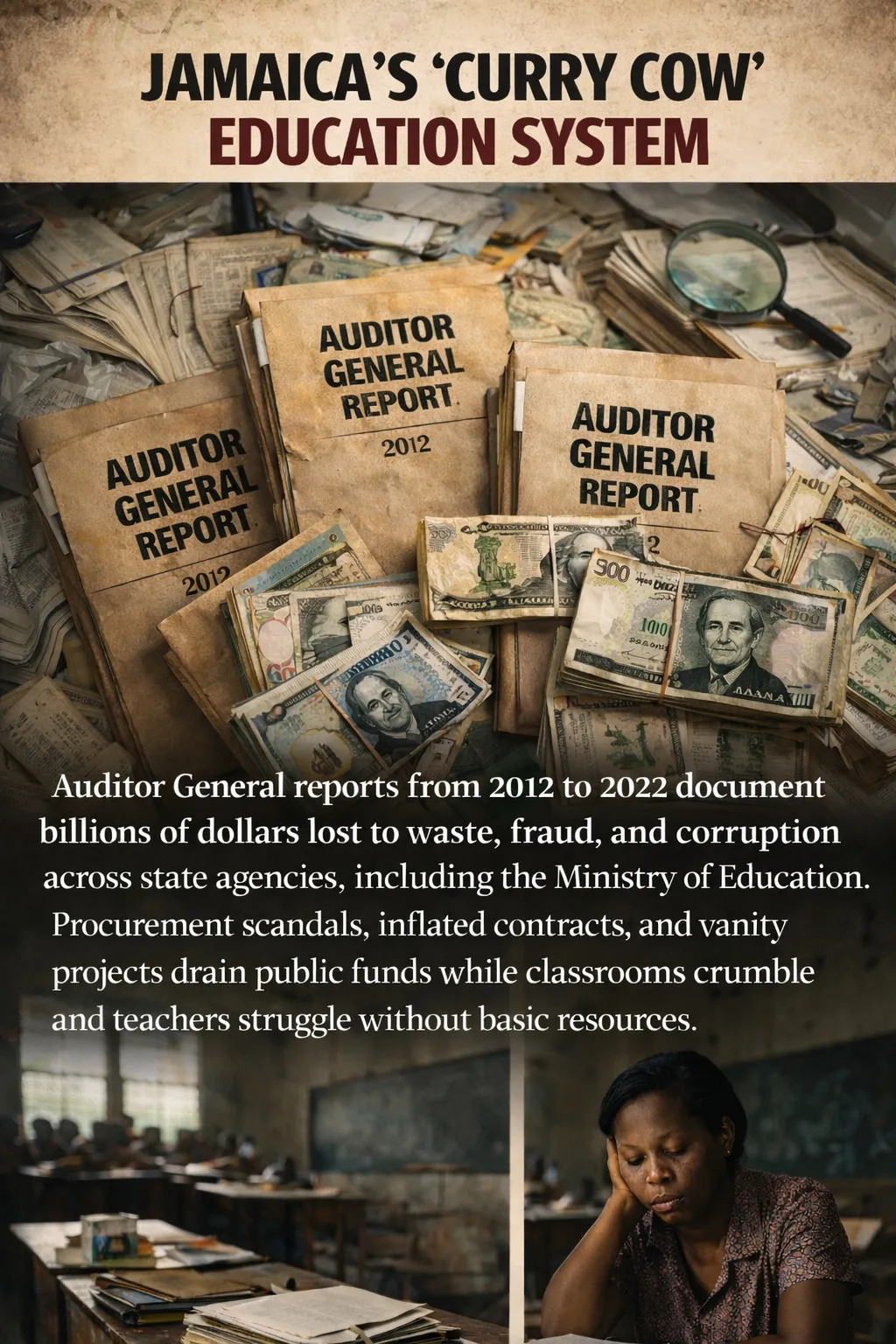
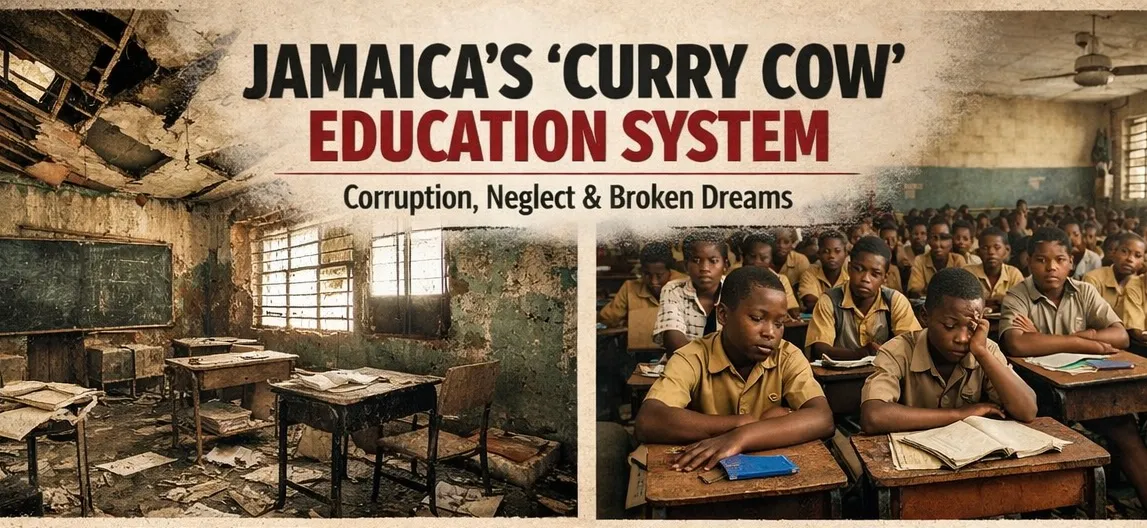
Jamaica’s Curry Cow Education: A Cultural Sovereignty Fight!


...Jamaica’s education crisis is rooted in corruption, colonial legacy, and mental slavery. Cultural sovereignty demands radical transformation now!

“We must emancipate ourselves from mental slavery, for though others might free the body, none but ourselves can free the mind.”

— Marcus Garvey


By Norris R. McDonald, Sulfabittas News Syndicate @sulfabittas

There are few tragedies more enduring than an education system that systematically undermines the very people it claims to uplift. In Jamaica, where more than 11 per cent of the adult population remains functionally illiterate, the consequence is not merely academic failure but the slow burial of potential.

Generations of children are being consigned to low-wage labour, economic uncertainty, destroyed hopes and dreams.


Jamaica's political and business elites thrive while the education system collape.

This crisis is not the result of scarce resources; it is the outcome of deliberate mismanagement, corruption, and a colonial mind-set that continues to shape the Jamaican society.

ELITISM, CULTURAL AND SOCIAL STAGNATION
Let us be clear: this is not accidental. From its inception, Jamaica’s education system was designed to serve a narrow elite while disciplining the majority into obedience. As Professor Errol Miller and others have long demonstrated, decades of reform have failed to close the gap between the privileged and the working class.

Instead, schooling continues to socialize our children into submission – training them to fit neatly into a global capitalist order where their creativity is extracted, their  labour exploited, and their aspirations contained.

My friends, the government’s endless parade of trust-deficit “solutions” has produced little beyond press releases and procurement contracts while fostering corruption.

Despite high enrollment, a United Nations study has found Jamaica’s learning outcomes to be dangerously weak. Only about 20 per cent of teachers are university graduates, and digital literacy remains an afterthought in a world increasingly defined by technology. Meanwhile, we continue to fund a system that reliably produces illiteracy, underemployment, and social stagnation.

We are producing societies with perpetual deep rooted poverty and social stagnation. 


A CORRUPTION-DRIVEN ‘CURRY COW’ EDUCATION SYSTEM

The crisis in education cannot be separated from Jamaica’s broader political economy. Government officials routinely cite budget constraints to justify chronic underinvestment, but this explanation collapses under scrutiny.


The problem is not scarcity; it is priority. Auditor General reports from 2012 to 2023 document billions of dollars lost to waste, fraud, and corruption across state agencies, including the Ministry of Education. Procurement scandals, inflated contracts, and vanity projects drain public funds while classrooms crumble and teachers struggle without basic resources.


This is a government that finds ample money for foreign travel, consultants and ceremonial excess, yet pleads poverty when asked to invest in children. Education has become a “curry cow” – a lucrative feeding trough for political insiders rather than a vehicle for national development.


Despite the rhetoric of reform, outcomes worsen, inequality deepens, and the gulf between elite institutions and underfunded public schools grows ever wider.


At its core, this dysfunction reflects the logic of capitalism itself. Jamaica’s education system is not designed to cultivate critical thinkers, innovators, or self-determining citizens. It is engineered to produce a compliant workforce for a global economy that thrives on cheap labour and limited horizons. Western capitalist nations preach meritocracy and opportunity, yet actively structure education to reproduce class hierarchies at home and dependency abroad. Minds are not developed; they are conditioned.


CUBA: A GOOD EXAMPLE AMERICA LOVES TO HATE


Contrast this with Cuba – a country relentlessly demonized and economically strangled by the United States and its allies for over six decades.


Despite an unforgiving blockade and material scarcity, Cuba has built one of the most successful education systems in the world, boasting near-universal literacy and strong outcomes across disciplines. This achievement is not rooted in excess wealth or cutting-edge technology but in political will.


Cuba consistently invests between 10 and 12 per cent of its GDP in education, prioritizing human development over profit. Education is treated as a public good and a cornerstone of sovereignty, not a commodity to be rationed or privatized.


In doing so, Cuba exposes the lie at the heart of capitalist ideology: that poverty, rather than policy, explains educational failure.


While Jamaica squanders public funds and bends to the dictates of international financial institutions, Cuba has built an education system that equips its people to participate in – and challenge – the global knowledge economy. Its success is not incidental; it represents a direct challenge to Jamaica’s, British inspired, colonial education system.


Cuba's educational system and outranks all developed, industrialized nations, including America. 


CREATIVITY, CULTURE AND NATIONAL SOVEREIGNTY


Cuba’s educational philosophy extends beyond the classroom. Creativity, culture, and community are central pillars of national development. Jamaica, by contrast, commodifies its cultural output — reggae, dancehall, athletics – without embedding creative education or economic ownership into the school system. 


Our global cultural influence has not translated into broad-based empowerment because we have failed to integrate creativity, technology, and heritage into a coherent educational strategy.


If Cuba can produce world-class doctors, engineers, scientists, and artists under siege, Jamaica has no excuse beyond political cowardice and ideological capture. Instead of cultivating national talent, our leaders defer to the IMF and their foreign masters. They therefore, wittingly or unwittingly, appear servile; pushing and implement policies that destroy the lives of black poor people and the middle class.


Loans replace vision, technical assistance substitutes for structural change.


My dear friends, what Jamaica requires is not more debt or donor-driven reform, but a fundamental reorientation of education toward cultural liberation rather than compliance.


EDUCATION MUST EMPOWER AND LIBERATE MINDS


Jamaica’s national hero Marcus Garvey warned that “a people without the knowledge of their past history, origin and culture is like a tree without roots.” He further reminded us that ‘we must emancipate ourselves from mental slaver to free our mind.’


Jamaica’s education system – shaped by colonial residue and enforced today through IMF and World Bank austerity – does precisely the opposite. It uproots African memory while institutionalizing mental captivity, training children for dependency rather than sovereignty.


Until education restores historical consciousness and rejects imperial supervision, political independence remains hollow, and liberation deferred.


Breaking free from colonialism and imperialism demands an education system rooted in black consciousness, cultural confidence, and national pride. Knowledge must be understood not merely as a means of survival, but as a weapon of resistance. 


We must abolish this education system that perpetuates ignorance, illiteracy and economic servitude and cultural enslavement.


Education must reflect the society it serves. 


If we desire a Jamaica that is just, sovereign, and self-determining, we must begin by transforming how and why we educate. 


Anything less is an endorsement of the cultural imperialist status quo.


That is the bitta truth.


AUTHOR

Norris R. McDonald
Author, writer and cultural commentator exploring Afro-Caribbean heritage, identity, and global influence.

👉 Want more stories on Afro-Caribbean culture, history, and global influence? Follow Afro Carib World for deeper insights.

BOOKS

BREAKING NEWS

Afro-Caribbean Culture, Garvey’s Vision and the fight for self-determination

Why Garvey's Vision Still Matters Today By Norris R. McDonald Afro Carib World, Updated, June 16, 2026 Afro-Caribbean culture emerged f...